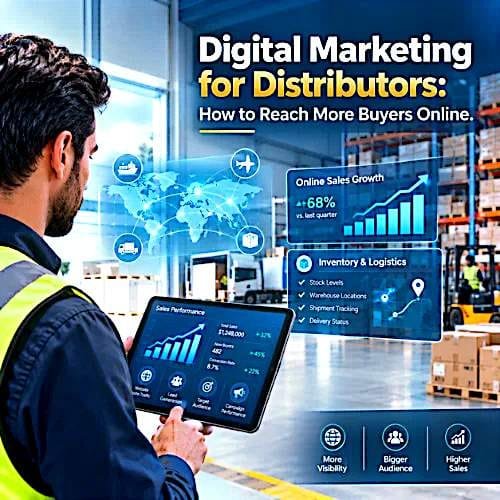
Digital Marketing for Distributors: How to Reach More Buyers Online

Implementing a tailored strategy for digital marketing for distributors allows wholesale businesses to connect with modern online buyers before competitors even get a call. Modern B2B procurement professionals conduct extensive digital research prior to reaching out to sales representatives. Distribution companies that rely exclusively on traditional cold calls or trade shows risk losing market share to agile digital competitors. By establishing a robust online presence, wholesale suppliers turn their digital channels into consistent revenue drivers. Partnering with industry-specific digital marketing experts helps distributors modernise their customer acquisition model.
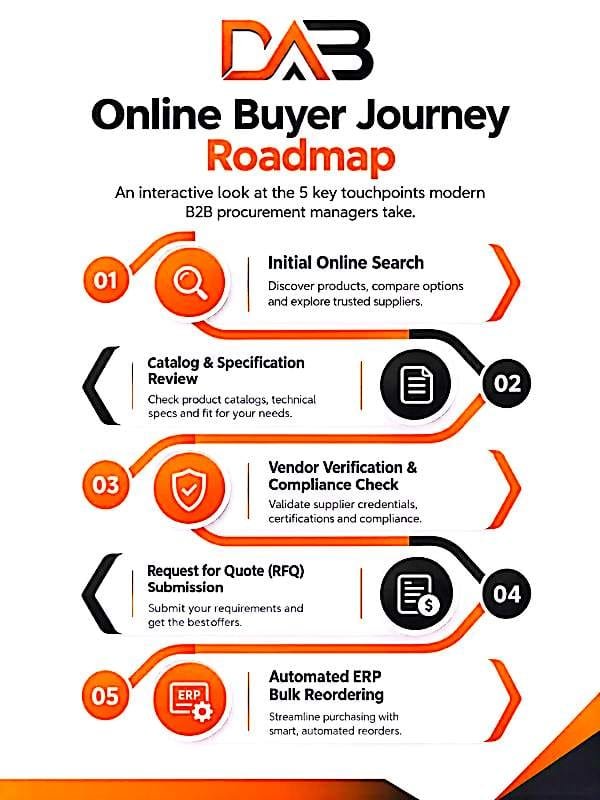
Infographic showing 5 steps of online buyer journey roadmap from initial online search to automated ERP bulk reordering for B2B procurement managers

Why Digital Marketing Matters for Distributors

The B2B purchasing landscape has undergone a permanent shift over recent years. Modern procurement managers and commercial buyers expect the same speed, convenience, and transparency online that they experience as retail consumers.

Digital channels enable distribution businesses to overcome geographical restrictions and expand into new commercial markets efficiently.

Here is why digital transformation is essential for wholesale growth:

  • Changing Buyer Demographics: Over 70% of B2B purchasing decisions are made by tech-savvy managers who research suppliers online first.
  • 24/7 Catalog Visibility: An optimized digital presence showcases product availability, technical specifications, and tier pricing constantly.
  • Sales Team Enablement: Qualified digital leads allow sales teams to spend less time prospecting and more time closing high-value accounts.
  • Measurable ROI: Unlike traditional offline advertising, digital marketing for B2B businesses offers precise tracking for every campaign dollar spent.

Without an intentional digital strategy, distribution companies remain invisible to buyers actively searching for immediate inventory solutions.

Best Digital Marketing Strategies for Distribution Businesses

A successful distributor marketing strategy requires a multi-channel approach aligned with B2B buying cycles. B2B buyers require detailed technical specifications, bulk ordering details, and proof of logistics reliability before placing an initial contract order.

Key strategies that form a complete distributor growth engine include:

  1. Search Engine Optimization (SEO): Captures high-intent buyers seeking specific SKUs or wholesale suppliers.
  2. Targeted Paid Advertising: Delivers immediate visibility for high-margin product lines across search and professional networks.
  3. Inbound Content Marketing: Educates buyers with whitepapers, spec sheets, and inventory guides.
  4. Account-Based Email Marketing: Nurtures prospective purchasing managers through automated drip campaigns.
  5. Conversion Rate Optimization: Converts anonymous site visitors into active wholesale account applicants.

Integrating these channels ensures your distribution business stays visible across every stage of the buyer journey. Combining organic visibility with structured PPC advertising services accelerates overall account acquisition.

SEO for Distribution Businesses

Search engine optimization provides the foundation for long-term distributor lead generation. When prospective clients search for bulk suppliers, specialized parts, or wholesale distributors, high search engine visibility ensures your website appears first.

Implementing specialized SEO for distribution businesses involves organizing your site architecture around buyer search intent. Categorize product lines clearly, build dedicated landing pages for major SKU categories, and publish comprehensive technical documentation.

Key components of B2B SEO include:

  • Keyword Targeting: Target high-intent transactional terms like wholesale industrial valve supplier or bulk electrical component distributor.
  • Technical SEO: Optimize site architecture, internal linking, and load speeds to support thousands of product SKU pages.
  • Local SEO Optimization: Ensure your regional warehouses and fulfillment centers rank prominently in localized map packs.

Implementing localized optimization through professional local SEO services guarantees dominance in regional supply territories.

Distribution Channel Comparison

ChannelObjectiveTimelineKey Advantage
Search Engine Optimization (SEO)Organic SKU capture3 to 6 MonthsHigh long-term ROI and sustainable search dominance
Pay-Per-Click (PPC) AdsImmediate buyer inquiries1 to 30 DaysRapid visibility for high-margin product lines
Content MarketingBuyer education & trust1 to 3 MonthsEstablishes domain authority and buyer confidence
Email MarketingAccount retention & reordersOngoingHigh-margin repeat bulk sales automation
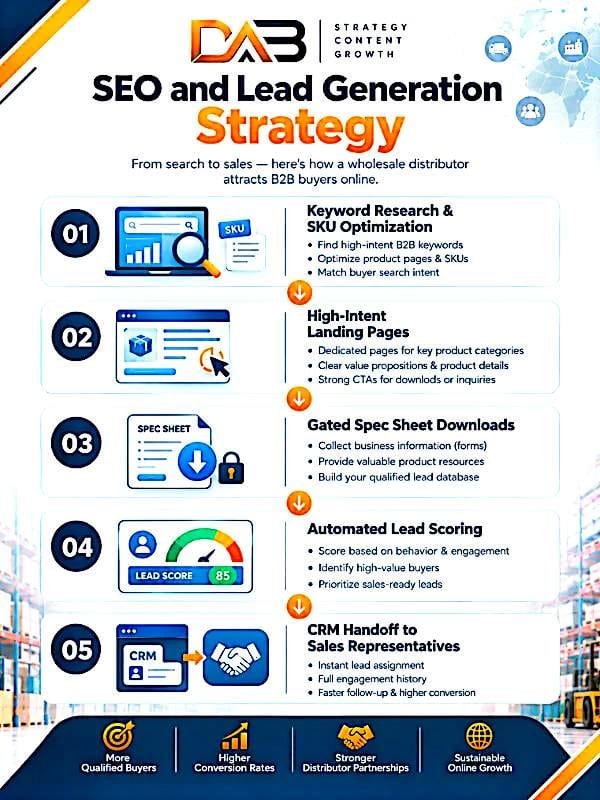
Infographic showing 5-step SEO and lead generation strategy for wholesale distributors including keyword research landing pages and CRM handoff

Content and Lead Generation

Content marketing transforms passive site visitors into qualified B2B leads. Commercial procurement teams require extensive documentation before committing to new distribution partners.

High-converting content formats for distribution marketing include:

  • Downloadable product specification sheets and dimensional CAD files.
  • Wholesale pricing guides and bulk discount structure breakdowns.
  • Industry compliance documentation and material safety data sheets (MSDS).
  • Comprehensive comparison guides comparing OEM and aftermarket components.

Pairing informative resources with structured content marketing services establishes authority across complex commercial sectors.

Automated email marketing services allow wholesale suppliers to follow up consistently with prospective purchasing leads.

Paid Advertising and Buyer Acquisition

While organic strategies build long-term value, paid advertising delivers immediate inbound opportunities. Pay-Per-Click (PPC) campaigns allow distributors to appear directly above organic results for high-value buyer search queries.

Effective paid media options for distributors:

  • Google Search Ads: Target commercial search terms capturing buyers with immediate purchasing intent.
  • LinkedIn Sponsored Content: Reach specific procurement titles, job functions, and company sizes directly.
  • Google Shopping / Performance Max: Display product photos, part numbers, and stock status directly in search results.

Combining paid search with strategic social media marketing services keeps your distribution brand top-of-mind across professional networks.

Website and Conversion Optimization

Your website functions as your primary digital sales portal. If prospective buyers struggle to navigate product catalogs or request quotes, they will quickly switch to a competitor.

Modern B2B distributor websites require:

  • Fast Mobile Performance: Ensure procurement agents can easily look up parts from job sites on mobile devices.
  • Streamlined Quote Requests: Replace lengthy contact forms with simple 1-click Request for Quote (RFQ) tools.
  • Clear Account Registration: Allow commercial clients to easily apply for wholesale credit accounts.

Upgrading your site via professional web design creates a frictionless experience that boosts conversion rates significantly.

Working alongside experienced digital marketing experts for your industry ensures your site layout maximizes incoming buyer inquiries.

Measuring Digital Marketing ROI

To scale your distribution marketing successfully, track actionable performance metrics that impact your bottom line.

Crucial metrics to track:

  • Cost Per Lead (CPL): Total marketing cost divided by inbound RFQs or account applications.
  • Customer Acquisition Cost (CAC): Total spend required to onboard a new active wholesale buyer.
  • Average Order Value (AOV): Growth in initial bulk purchase amounts.
  • Customer Lifetime Value (LTV): Overall revenue generated over years of recurring wholesale orders.

Reviewing performance analytics allows your business to reallocate budget toward top-performing channels continuously.
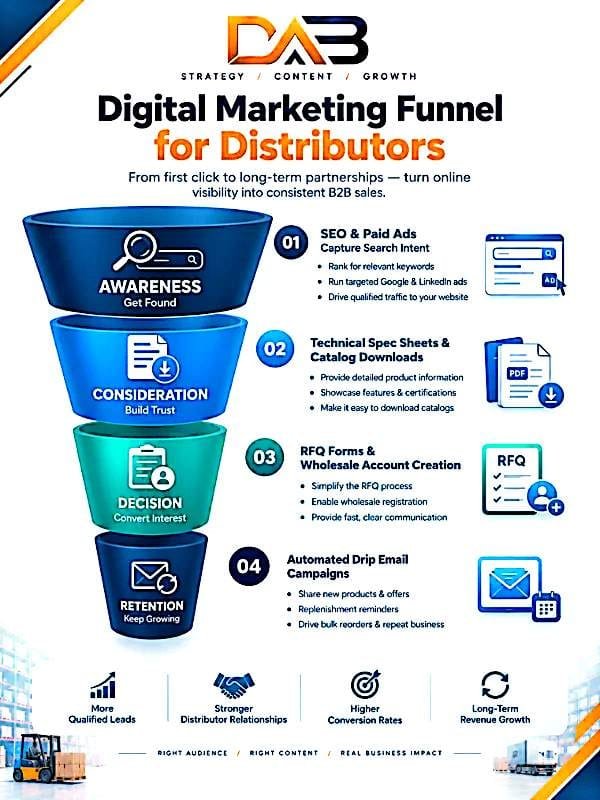
Digital marketing funnel infographic for distributors showing 4 stages awareness consideration decision retention from SEO to automated email campaigns

Key Takeaways

  • B2B buyers complete most research online before contacting wholesale representatives.
  • Comprehensive SEO captures high-intent searches for specific parts, categories, and inventory supplies.
  • Gated content like spec sheets and pricing guides turns anonymous visitors into qualified leads.
  • Targeted Google Ads and LinkedIn campaigns deliver immediate visibility for high-margin products.
  • A fast, user-friendly website with simple RFQ forms maximizes conversion rates.

Frequently Asked Questions (FAQs)

  1. How does digital marketing for distributors differ from B2C marketing?
    Distributor marketing focuses on long sales cycles, multi-person decision units, bulk pricing structures, and technical specifications, unlike high-volume B2C impulse sales.
  2. Which digital marketing channel yields the highest ROI for wholesale distributors?
    SEO combined with targeted email marketing consistently delivers the highest long-term return on investment for distribution companies by capturing organic search demand.
  3. How long does it take to see results from distributor SEO campaigns?
    While paid search offers immediate inquiries, comprehensive SEO campaigns typically demonstrate significant lead growth within 3 to 6 months.
  4. Should wholesale distributors display prices openly on their website?
    Displaying tier pricing or requiring account login for bulk discounts protects margins while encouraging prospective online buyers to register as leads.
  5. How can social media benefit B2B distribution businesses?
    Platforms like LinkedIn allow distributors to build brand authority, target specific procurement managers, and share corporate inventory updates.
  6. What is the role of content marketing in B2B lead generation?
    Content marketing educates buyers with spec sheets, case studies, and comparison guides, lowering buyer risk and increasing account sign-ups.
  7. Why is local SEO critical for regional distributors?
    Local SEO ensures your regional fulfillment centers appear prominently in Google Map Packs when local buyers search for immediate regional stock.
Conversion Rate Optimization in Abbotsford: Double Your Revenue (2026)

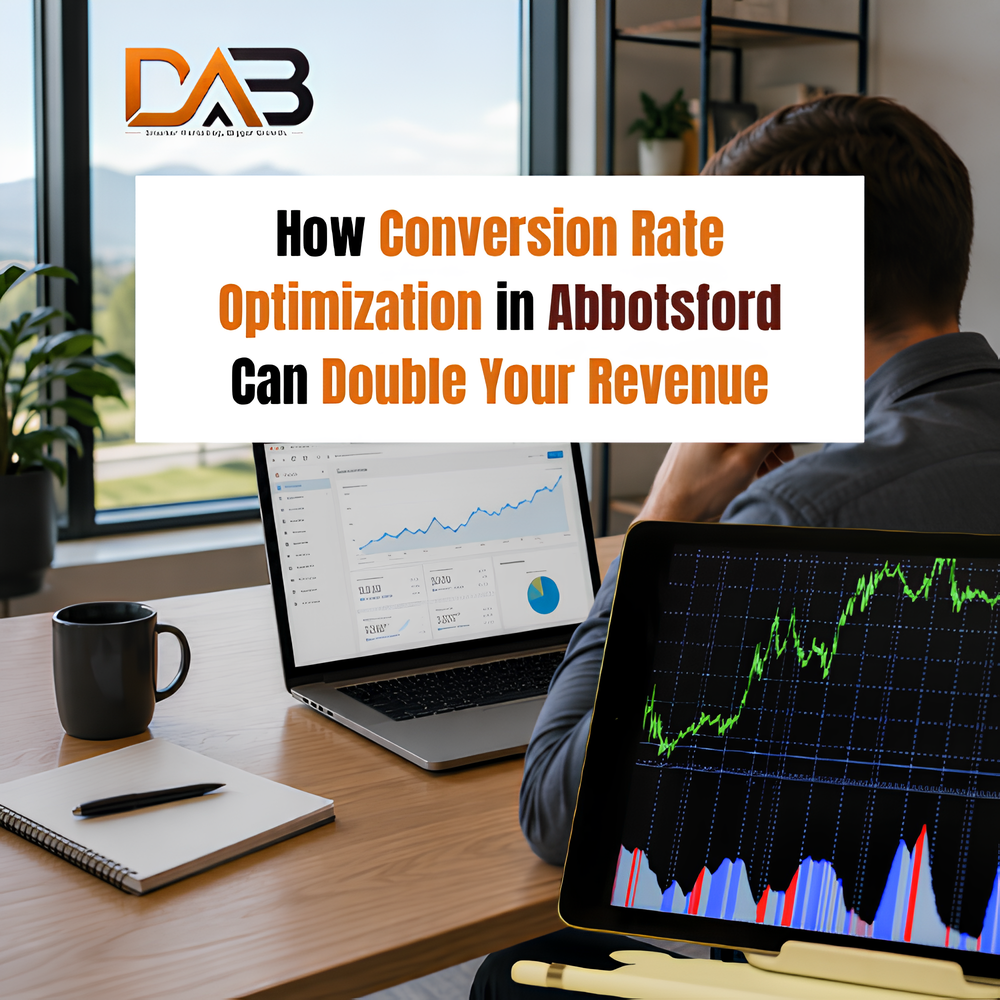
How Conversion Rate Optimization in Abbotsford Can Double Your Revenue

Conversion rate optimization in Abbotsford is the process of improving your website so more visitors take action without increasing ad spend. Most local business sites convert 1 to 3 percent of visitors. Targeted CRO improvements to page speed, calls to action, and user experience can double that rate within 60 to 90 days.

If your Abbotsford business is paying for traffic but not seeing enough leads, the problem is almost certainly your conversion rate, not your marketing budget. Our professional SEO services in Abbotsford at DigiAIBiz are built alongside conversion strategy from the start, because ranking on Google delivers no revenue if your website does not close the visitor. As a leading digital marketing agency in Canada, we have seen Abbotsford businesses double their leads simply by fixing what was already broken on their existing site. Going from a 2 percent to a 4 percent conversion rate produces the same result as doubling your traffic, with zero extra ad spend. This guide covers exactly how to make that happen.

What Is Conversion Rate Optimization?

Conversion rate optimization (CRO) is the systematic process of increasing the percentage of website visitors who take a desired action. For most Abbotsford businesses, that action is calling, filling out a contact form, booking a service, or making a purchase.

Formula: Conversion Rate = (Number of Conversions / Total Visitors) x 100

If 300 people visit your site and 6 contact you, your conversion rate is 2 percent. CRO raises that number through better design, clearer messaging, faster page loads, stronger calls to action, and less friction across the entire user journey.

BenchmarkRateSource
Average conversion rate, all sectors1.7%HubSpot, Q3 2025
Service businesses with local search intent2 to 5%KihanMarketing, 2026
Top-performing local landing pages5 to 11%GreetNow, 2026
Google Ads average conversion rate7.52%WordStream, 2025
Mobile vs desktop conversion gap2% vs 4.1%GreetNow, 2026

Why Abbotsford Businesses Lose Conversions Right Now

Abbotsford is a competitive market. Trades companies, healthcare providers, restaurants, retail stores, and professional services all compete for the same pool of ready-to-buy customers searching Google every day.

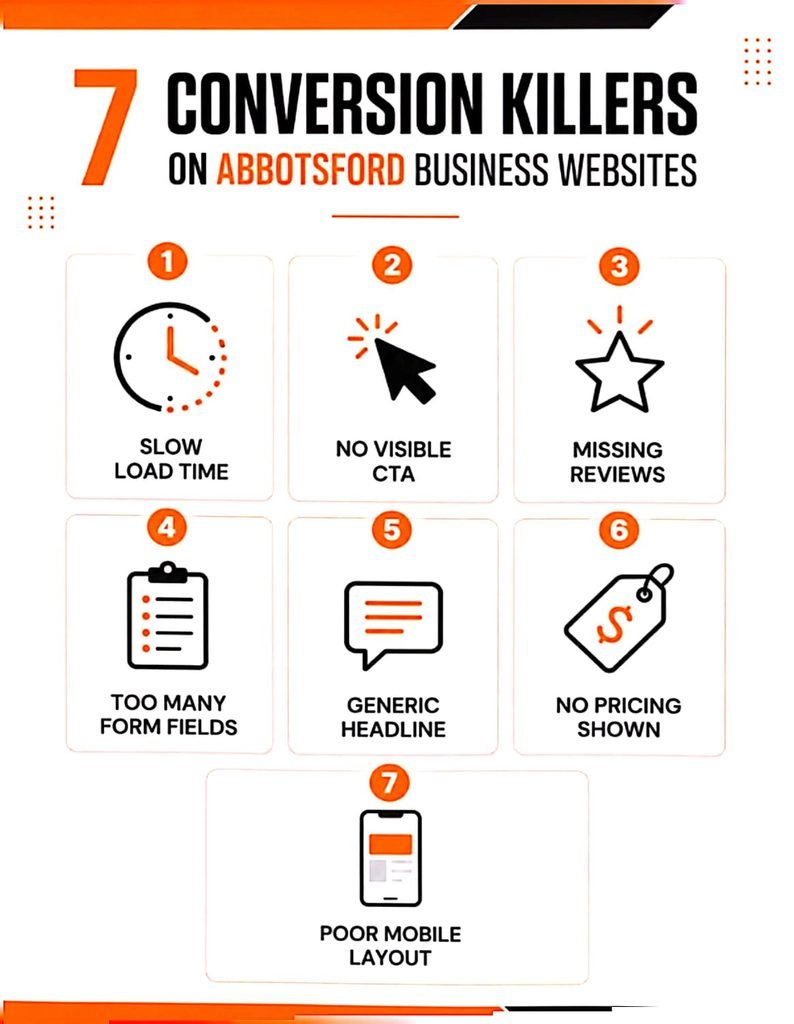
Most Abbotsford business websites were built to look professional. Very few were built to convert. The most common conversion killers we find on local BC sites are:

  • Pages taking longer than 3 seconds to load on mobile
  • No clear call to action visible without scrolling on the homepage
  • No Google reviews or certifications visible near the top of the page
  • Contact forms with 8 to 10 required fields before reaching you
  • Generic headlines that do not speak to the visitor’s specific need
  • Poor mobile layout affecting over 60 percent of local searches
  • Pricing completely absent, causing visitors to leave and compare elsewhere

Each of these issues is fixable without rebuilding your website. A targeted CRO audit finds which ones are costing you the most leads.

7 CRO Strategies That Work for Abbotsford Businesses

Strategy 1: Fix Page Load Speed First

Page speed is the single highest-impact technical fix available. A one-second delay in load time reduces conversions measurably, and on mobile the effect is amplified. Compress images to WebP format, enable browser caching, and eliminate render-blocking scripts to bring load time below 3 seconds.

Use Google PageSpeed Insights and Core Web Vitals to identify exactly which elements are slowing your site down.

Strategy 2: Make Your Value Proposition Unmissable Above the Fold

The first screen a visitor sees without scrolling must answer three questions immediately: what you do, who you serve, and what they should do next.

Replace vague taglines with specific claims. “Abbotsford’s trusted emergency plumber, available 24 hours” converts better than “Your local plumbing experts.” Specificity builds trust before the visitor reads a single paragraph.

Strategy 3: Add Trust Signals at the Top of Every Page

Google reviews, industry certifications, years in business, and photos of real work done in Abbotsford all build confidence quickly. Place these above the fold, not buried in a footer or on a separate testimonials page.

Stat: Businesses displaying customer reviews convert up to 270 percent better than those without. (Spiegel Research Center)

Strategy 4: A/B Test Your Calls to Action

A/B testing runs two page versions simultaneously to identify which converts better. Small changes to button text, color, size, or position produce surprisingly large differences in form submissions.

Run tests for at least two weeks with a minimum of 500 visitors per variant before drawing conclusions from the data.

Strategy 5: Reduce Contact Form Fields to the Minimum

Every extra form field reduces submission rates. For most Abbotsford service businesses, a contact form needs only three fields: name, phone or email, and what they need help with.

Everything else can be collected after the lead comes in. A shorter form signals low effort to the visitor, which increases the likelihood they complete it.

Strategy 6: Use Heatmaps to See What Visitors Actually Do

Tools like Hotjar and Microsoft Clarity show exactly where visitors click, scroll, and exit. This behavioral data replaces guesswork with evidence.

Common findings on BC-based service sites include visitors clicking non-linked images expecting navigation, scrolling past prominent CTAs, and abandoning pages immediately when pricing information is absent.

Strategy 7: Optimize the Mobile Experience Completely

Mobile devices convert at roughly half the rate of desktop, approximately 2.0 percent versus 4.1 percent (GreetNow, 2026). For Abbotsford customers searching on their phones, that gap represents direct revenue being left behind.

Large tap targets, a prominently placed click-to-call button, and a fast contact process with minimal scrolling are the three most important mobile fixes for any local service business.

CRO and SEO: How They Work Together

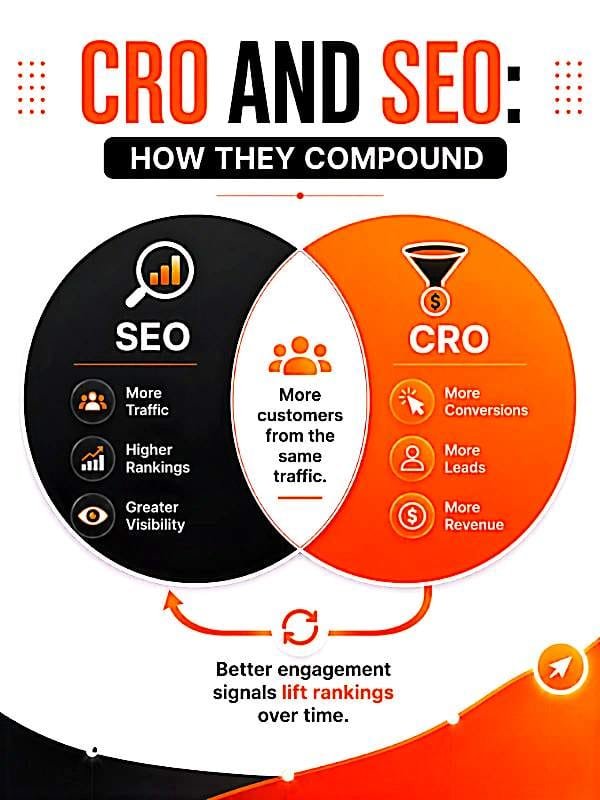
CRO and SEO are often treated as separate priorities by Abbotsford businesses. In practice, they reinforce each other in ways most local companies are not using.

Google’s ranking signals increasingly include user engagement data: time on page, scroll depth, and bounce rate. These metrics improve directly when CRO is done well. A website that converts well also signals quality to Google, which supports organic rankings over time.

At DigiAIBiz, our full-service digital marketing solutions combine both disciplines by design. There is no value in ranking on page one if the landing page fails to convert the visitor into a lead. CRO and SEO are built together from the start of every campaign we run for Abbotsford clients.

What a Professional CRO Audit Covers

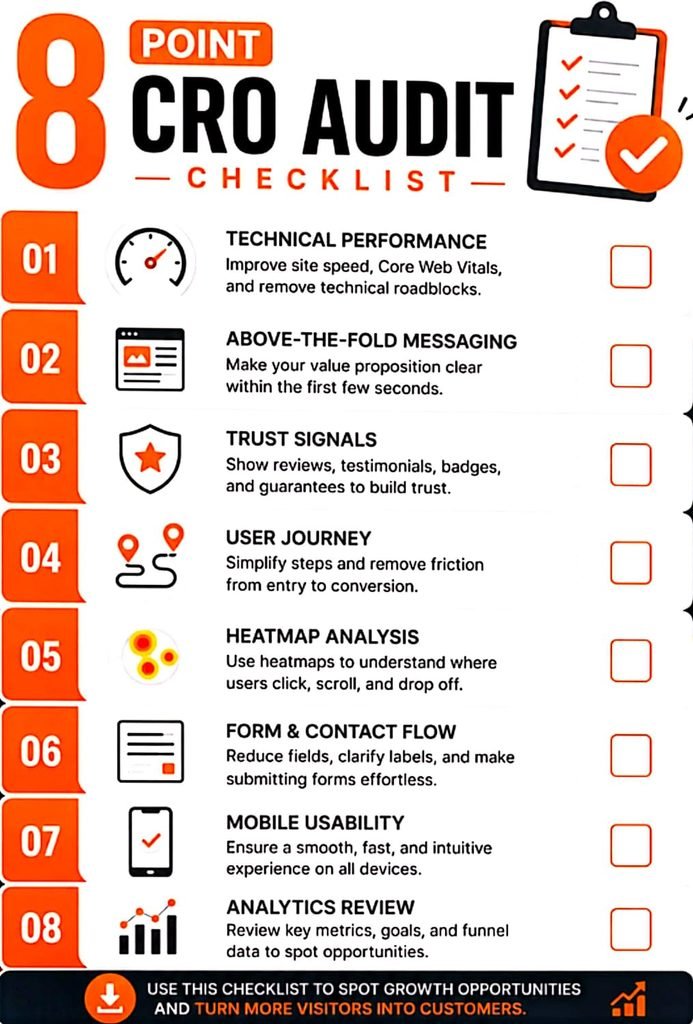
When DigiAIBiz audits an Abbotsford business website for conversion performance, the assessment covers eight core areas ranked by revenue impact:

Audit AreaWhat We Assess
Technical performanceCore Web Vitals, mobile load speed, PageSpeed score
Above-the-fold messagingValue proposition clarity, CTA visibility before scroll
Trust signalsReviews, certifications, local references visible at top
User journey mappingNavigation flow, exit pages, drop-off points in funnel
Heatmap and scroll analysisClick patterns, scroll depth, rage clicks, dead zones
Form and contact flowField count, friction points, confirmation experience
Mobile usabilityTap target sizing, layout integrity, speed on 4G
Analytics reviewBounce rates, session duration, conversion by source

After the audit, DigiAIBiz delivers a prioritized improvement list ranked by expected revenue impact. Most Abbotsford businesses have three to five fixable conversion killers on their homepage alone. According to the City of Abbotsford Economic Development resources, the Fraser Valley region supports thousands of small and medium businesses competing in increasingly digital-first markets.

Key Takeaways

  • Doubling your conversion rate from 2 to 4 percent produces the same revenue growth as doubling your traffic
  • Most Abbotsford business websites have three to five fixable conversion killers that owners are not aware of
  • Page speed, a clear value proposition, and visible trust signals deliver the fastest measurable conversion gains
  • CRO and SEO work together: a site that converts well also sends stronger ranking signals to Google over time
  • A/B testing and heatmap analysis remove guesswork and replace assumptions with behavioral evidence
  • A professional CRO audit typically shows measurable improvements within 60 to 90 days of implementation
  • Reducing form fields to three or fewer is one of the lowest-effort, highest-return changes any local business can make

Frequently Asked Questions

What is a good conversion rate for an Abbotsford business website?

A good conversion rate for Abbotsford service businesses is 2 to 5 percent of total visitors. Local service businesses with high-intent search traffic, such as trades, healthcare, and legal services, often convert above this range because visitors arrive with a specific need already identified.

How long does it take to see results from CRO?

Technical fixes such as page speed and mobile UX often show results within 2 to 4 weeks. A/B tests require at least two weeks and 500 or more visitors per variant to produce statistically reliable data, and comprehensive CRO programs typically deliver measurable conversion gains within 60 to 90 days.

Do I need to rebuild my website to improve conversions?

Most Abbotsford businesses do not need a full website rebuild. Targeted changes to headlines, CTAs, form design, trust signals, and page speed typically deliver 30 to 50 percent conversion improvements without touching the overall site architecture or existing content structure.

Is CRO worth the investment if my traffic is currently low?

CRO is especially valuable for low-traffic Abbotsford businesses. Improving from 1 to 3 percent conversion with 500 monthly visitors goes from 5 leads to 15 leads with no additional ad spend. Combining CRO with local SEO builds both traffic volume and conversion rate at the same time.

Can CRO improve the performance of my Google Ads campaigns?

Yes. Google Ads charges per click regardless of whether the visitor converts. A landing page converting at 5 percent generates 2.5 times more leads per dollar than one converting at 2 percent. Better conversion rates also improve your Google Ads Quality Score, which reduces your cost per click over time.

What tools does DigiAIBiz use for CRO work?

The core tools are Google Analytics 4 for conversion tracking, Hotjar or Microsoft Clarity for heatmaps and session recordings, Google PageSpeed Insights and Core Web Vitals for technical performance, and platform-native A/B testing tools for controlled experiment management. All recommendations are data-backed.

How is a CRO audit different from an SEO audit?

An SEO audit focuses on how well your site attracts traffic from search engines, covering rankings, crawlability, and keyword coverage. A CRO audit focuses on what happens after the visitor arrives, specifically why they do or do not take action. Running both together gives the complete picture of your site’s revenue performance.